Ontario’s Latest Capacity Procurement (LT2c Window 1)
BESS continues to outcompete new gas – even with 2x the duration
June 30, 2026
In June 2026 the IESO released initial results for its Long-Term 2 capacity procurement (LT2(c-1)), awarding 20-year contracts to three battery storage (BESS) projects totalling 640 MW.
The IESO’s LT2(c-1) was the third competitive procurement for new capacity since 2023, following the Expedited LT1 (E-LT1) and LT1 rounds, and part of a broad set of IESO procurements for existing and new energy and capacity. LT2(c-1) marked two firsts: it was the first IESO round in which storage competed directly against gas, and the first to require a minimum of eight hours of duration (double that of prior procurements). In earlier IESO procurements, separate targets for each technology had let gas clear at a higher price. Despite several advantages extended to gas, no gas project cleared.
LT2(c-1) tracks two global trends: BESS is displacing gas for new capacity, and project returns increasingly depend on merchant revenue that rewards flexibility over low marginal cost. The Ontario results bear this out in four ways:
- Ontario's storage penetration to be among the highest in North America: 3.6 GW of battery storage, contracted in only three years, will reshape Ontario's capacity mix, reaching 8% of provincial capacity by 2030.
- Battery costs have fallen while gas peaker costs have risen: BESS capital costs, already able to benefit from the 30% Investment Tax Credit (ITC), have fallen further as battery prices dropped sharply while gas turbine prices skyrocketed.
- Monetizing multiple grid services is central to BESS cost competitiveness: BESS projects can expect more IESO market revenue, lowering capacity prices, with nascent opportunities emerging to monetize the value of deferring transmission investments.
- Capital invested in Ontario power increasingly depends on the wholesale market for returns: LT2 continues the trend of project investors, both equity and debt, investing in Ontario’s wholesale markets, something unheard of prior to the recent procurements.
Foundation Economics has supported clients with bid strategy, competitive analysis, and pricing support in both the LT2 energy and capacity streams, as well as other procurements across North America. This post draws on our market knowledge and publicly available results to offer perspective on what this procurement reveals and where the Ontario market goes from here.
IESO Energy Storage Procurements
Results at a Glance
Across four storage procurements since late 2022 (three competitive and one bilateral), the IESO has contracted ~3.6 GW, and capacity prices have fallen steadily.
The chart at right sets LT2(c-1) against the storage procurements that came before it. Capacity prices have fallen 36% from the Expedited LT1 at $881/MW-day (the first competitive round in February 2023) to LT2(c-1) at $563/MW-day. Oneida, a directed bilateral award, carried a pricing formula indexed to lithium and is assumed to have settled in Q3 2023; E-LT1 and LT1 offered proponents similar indexation options, and the prices shown are before any such adjustment, which many winners are assumed to have declined.
Seeing continued price declines with LT2(c-1) is a remarkable result, as this was the first round to require eight hours of duration, double the four hours of earlier rounds. Much of a battery's cost sits in the cells themselves, which double as duration doubles. Longer duration therefore captures only limited economies of scale, mostly in EPC, interconnection, and overhead. Restating the prices per unit of storage capacity to account for the change in duration1 Dividing the $/MW-day capacity price by hours of duration expresses cost on a $/MWh-day basis, the fall in prices is from ~$220/MWh-day in E-LT1 to about $70/MWh-day in LT2(c-1), a remarkable 68% decrease in three years.
All three winners earned the maximum rated criteria points for Indigenous participation, each with 50% First Nations ownership, in line with recent rounds. Only one project earned the additional Northern siting points, worth a 4% reduction in its evaluated price.
Changes to Ontario Capacity Mix
Before and After IESO Storage Procurements
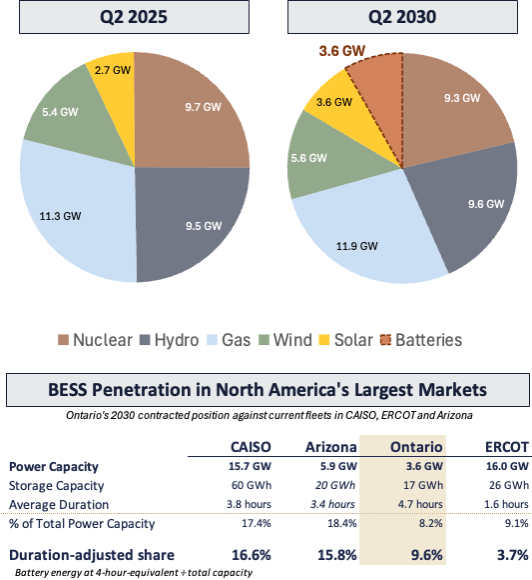
Ontario’s Capacity Mix is Transforming
The storage procurements are one piece of a broader build cycle happening in Ontario. After a decade of little new build, several procurements are now adding supply at once. The recent LT2 energy contracts add 1.1 GW of new intermittent renewables, mostly solar. Darlington's four units have just completed a decade-long refurbishment, and Bruce has six more units in refurbishment into the early 2030s, keeping nuclear central to Ontario’s energy supply. The first genuinely new nuclear, a 300 MW SMR at Darlington, is targeted for 2030.
The build-out extends well beyond this decade. Three more SMRs will bring Darlington to 1,200 MW, and early planning is underway for large-scale nuclear at Bruce and Wesleyville that could add several more gigawatts. The new Long Lead-Time RFP, offering 40-year contracts for up to 1 TWh of new energy, expected to support new hydro, adds another stream. Together, this will be Ontario's largest sustained generation build-out since the nuclear expansion of the 1970s and 80s.
The contracted storage build alone reshapes the market. By 2030, when all awarded projects are online, 3.6 GW of storage will be operating, around 8% of total provincial capacity. That ranks Ontario among the largest storage markets in North America, and third on a duration-adjusted basis, behind only California and Arizona.2 As a percent of total installed capacity
This also challenges an assumption long taken as a given across the industry. Gas has been viewed as the marginal resource in two senses: its marginal operating cost is expected to set the energy price the majority of the time, and a new gas plant is the assumed next unit built, the benchmark that constructs like the cost of new entry (CONE) are calibrated around. As storage displaces gas in both roles, a reference point markets have rested on for decades falls away. How prices form when storage, not gas, sits on the margin is still an open question. Ontario, set to be one of the most storage-heavy grids on the continent, will be among the first to provide an answer.
Battery Storage and Gas Peaking Projects in Development and Contracted Since 2022
Identified projects based on Foundation Economics’ proprietary database
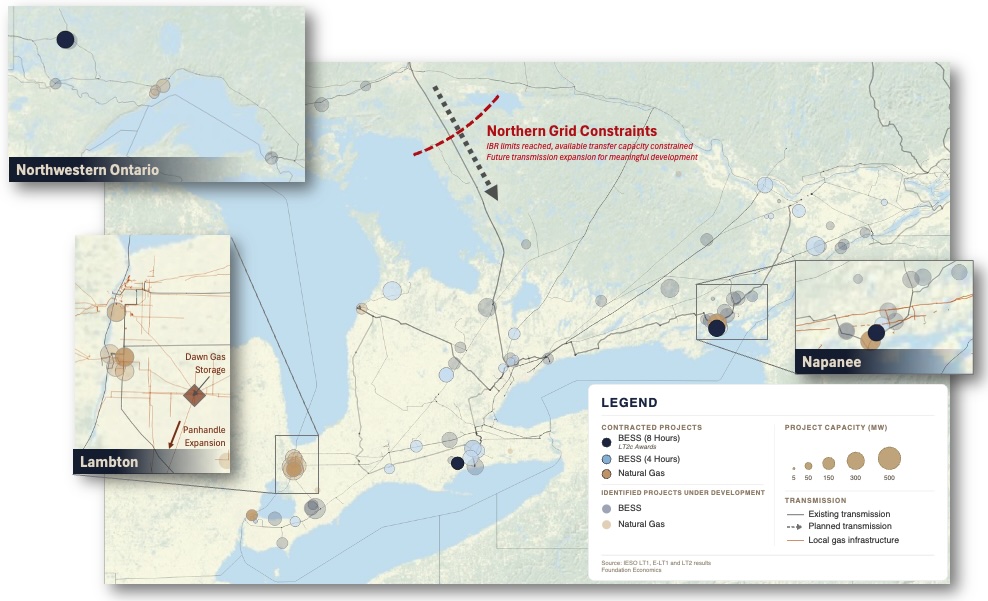
Foundation Economics identified 40 BESS projects (~6 GW) and 9 gas peaking projects (~2 GW) as possible bidders in LT2(c-1). Together, this represents ~12x the 640 MW awarded. Although not every project is expected to have bid, this points to a competitive, heavily oversubscribed RFP.
Battery development is spread fairly evenly across southern Ontario, with two clusters around Niagara and Napanee. The Napanee area attracted heavy developer interest in LT2(c-1), drawn by known transmission capacity and the absence of deliverability constraints.
In contrast to the dispersion of BESS projects, gas development was concentrated almost entirely in the industrial Lambton region, close to the Dawn storage hub. Several smaller reciprocating engine projects in the North were a notable exception.
Only one of the three awarded projects for the LT2(c-1) capacity RFP is located in northern Ontario despite three rated points (a 4% benefit). That stands in sharp contrast to the LT2 energy RFP, where nearly all awarded projects were in the North. The IESO communicated a 1,000 MW constraint for inverter-based resources (IBRs, including wind, solar, and batteries) in the North, applied cumulatively across the LT2(e-1) and LT2(c-1) awards. Over 1.2 GW was awarded in the energy RFP, so northern BESS was expected to be constrained. The 200 MW Gichigami Wind later declined to sign, which may have opened just enough room for the 190 MW Eagle Lake to be awarded.
Divergent Cost Trajectories: Battery Prices Fall as Turbine Prices Rise
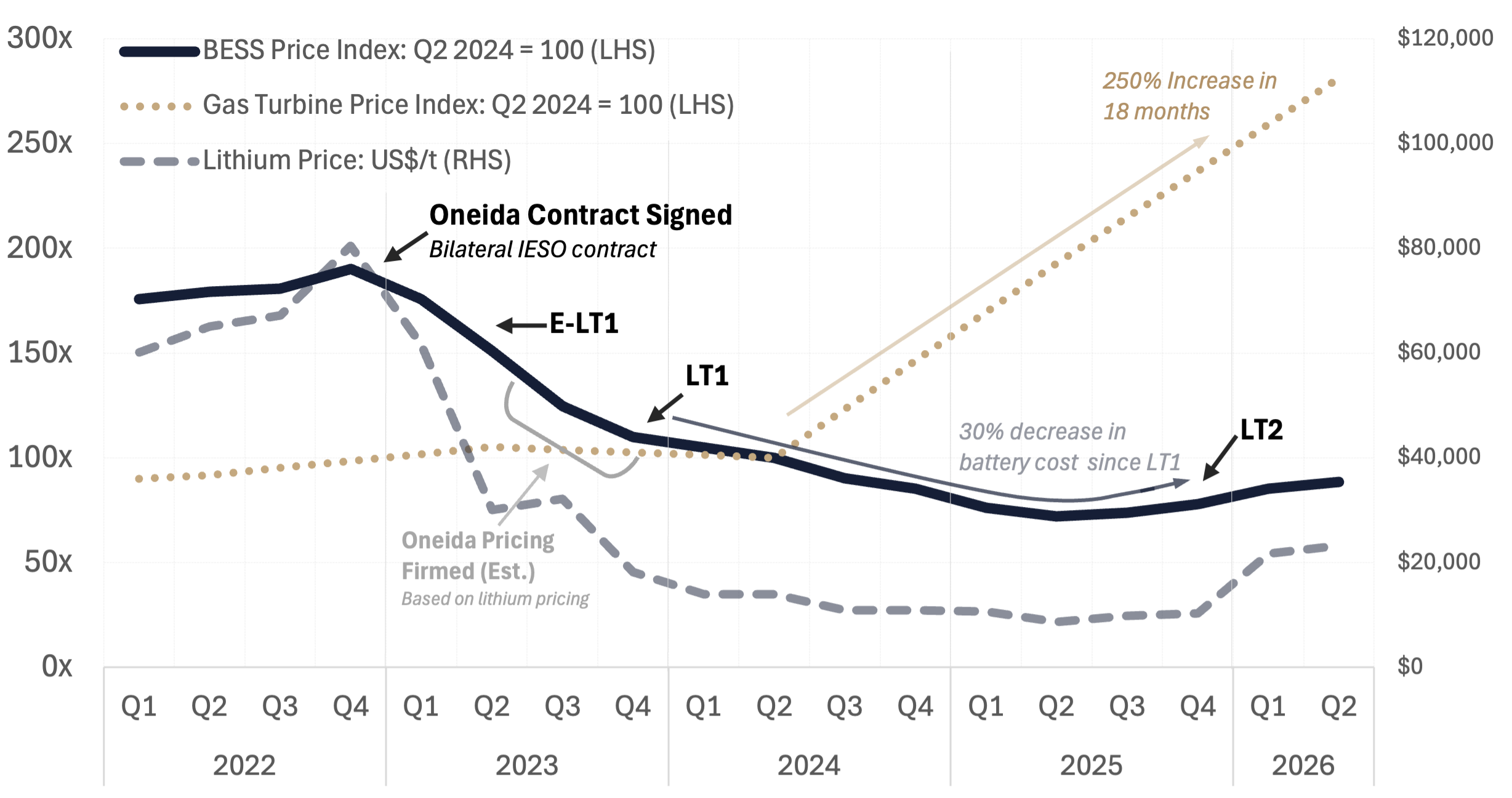
Over the three years between the Oneida award and the LT2 bid deadline, the cost of battery equipment fell ~50%. Much of this decline tracked the price of lithium (the single largest input cost in a battery cell), which fell about 66% over the same period. But efficiency improvements also accelerated the decline: the supply chain has scaled enormously, installers and operators have moved down a steep learning curve, and growing project sizes have supported lower bids.
Because developers submit bids before equipment is secured, those falling prices have worked in project developers' favour, and some bidders may have banked on further declines between bid and procurement. Nonetheless, as illustrated by our BESS Price Index below, battery costs have risen since Q4/2025 (the first such increase since 2022) as lithium prices rebounded. This reversal of the trend of declining costs provides a reminder of the risk in banking on continued declines.
Since Q2/2024 period, gas turbine costs have risen ~250%, driven by a sudden surge in demand from data centres. This follows more than a decade in which renewables met most incremental energy demand, leaving turbine orders to slide and manufacturers to trim production. When demand rebounded, the manufacturing capacity to absorb it was gone, and prices spiked.
The major manufacturers are now expanding: GE Vernova is ramping toward 20 GW of annual turbine output by 2026, Siemens Energy is reactivating its Charlotte turbine line after a roughly six-year idle, and Mitsubishi has announced plans to roughly double its turbine capacity. As that capacity comes online, today's elevated prices and multi-year lead times should ease.
Battery and Gas Turbine Cost Trends
Battery Pack Cost Index vs. Gas Turbine Cost Index
Battery Economics Overcame an RFP Built to Favour Gas
For a round meant to put gas and storage in direct competition, the RFP and contract carried several explicit advantages for gas:
- First, a gas project earned 3 additional rated points over an eight-hour battery for its longer dispatch duration, reducing its evaluated price by 4%.
- Second, the IESO absorbed future policy risk, including the prospect of Clean Electricity Regulations (CER) or equivalent measures limiting gas dispatch after 2035.
- Third, proponents could delay contract start and extend the term in the event of a gas turbine delivery delay, a direct response to the long lead times now affecting turbine supply.
- Fourth, through a late addendum the IESO agreed to absorb 75% of the cost of upstream gas-transmission upgrades triggered when a unit connects to the gas distribution network.
The cost-absorption addendum particularly boosted the competitiveness of new gas. Most gas projects are clustered in Lambton and would connect to that network, so it addressed a real cost risk for the bulk of the gas fleet, though it offered nothing to the few northern projects sited outside it. A new gas peaker can trigger upstream network upgrades, often unknown at the time of bid. Enbridge's recent Panhandle Regional Expansion, a transmission build between the Dawn storage hub and Windsor, shows how large that cost can be: about 53% of its $358 million cost served roughly 640 MW of new gas generation. A similar upgrade for a Lambton peaker would add an estimated $100 to $155 per MW-day, roughly 18 to 28% of the LT2 cleared price, a cost storage does not carry.
Yet despite the features meant to improve the competitiveness of gas in LT2(c-1), the economics of building new gas remain less favourable than new BESS. The last gas unit to clear was the Napanee expansion in LT1, in Q4/2023, a round in which gas did not compete directly against storage. It was awarded $1,674/MW-day, nearly 3x the LT2(c-1) clearing price and ~2.5x the average storage contract in that same procurement. That bid was likely inflated by thin competition, with few gas projects advanced enough to bid, but gas turbine costs have risen roughly 250% since. Turbine inflation makes a materially lower clearing price unlikely, and costs for new gas capacity remain multiples above storage either way.
The advantages the IESO extended to gas in LT2(c-1) were deliberate, likely signalling its view that new gas capacity will be required. Selecting on price alone does not reward the attributes that make gas valuable for reliability. A battery's capacity value erodes as storage saturates, each new unit adding less to peak demand as the remaining peaks run longer than storage can cover. Gas, with no duration limit, holds its capacity value throughout. It is also synchronous, supplying inertia that an inverter-based fleet of batteries, wind, and solar does not. The IESO may therefore pursue a technology-specific procurement. The default assumption is that this will be won by a combustion turbine in the Southwest. We see a competitive opportunity for different technologies, such as reciprocating engines, built away from the crowded Southwest.
Contracted vs. Merchant Revenues
Hypothetical dispatch over past 12 months
BESS Merchant Advantage
A Blessing and a Curse
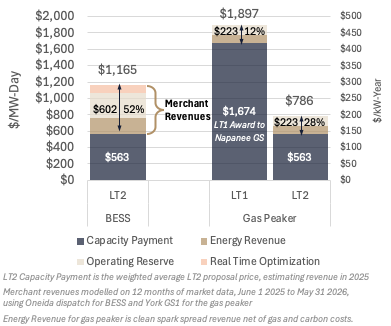
Merchant revenue is central to the BESS business case. The chart at right shows what a representative storage project and a gas peaker are estimated to have earned over the past twelve months, using the actual dispatch of assets operating today.
Assuming a capacity contract consistent with the LT2 award, such a representative BESS earned more from the wholesale markets, energy arbitrage and operating reserve (together >50% of its total revenue), than from its capacity contract.
A gas peaker cannot match that. Over the same period, a representative gas peaker would have earned far less in the market: 28% of revenue at a capacity price consistent with LT2(c-1), and only 12% at the price gas received in LT1.
A peaker is typically on the margin when it is dispatched and therefore captures very little spread over its running cost (spark spread). In contrast, a battery earns a spread most days it dispatches (energy arbitrage). On top of that, BESS assets are far more flexible, allowing them to sell more operating reserve at higher value, and optimize their dispatch in real time. This difference is a competitive advantage for BESS: a battery can bid a lower capacity payment because it expects to make up the difference in the market.
The growth of energy storage, and the contract structures the IESO has used over the past three years, marks a real shift for Ontario. Before the storage procurements, new generation was nearly fully contracted, and investors typically discounted any merchant revenue when underwriting a project. Storage investors are now underwriting a majority of a project's revenue from merchant streams that depend on future market prices and the operator's ability to dispatch efficiently, and lenders are increasingly willing to lend against it.
However, these merchant revenues are volatile and difficult to confidently project decades into the future – particularly with an increasing degree of BESS penetration. The revenue streams depend on thin ancillary markets and on price spreads rather than on the absolute price levels. In a typical year much of a battery's wholesale earnings arrive in a handful of scarcity-priced hours, often clustered in a single month, and some years deliver far more than others. Last winter's polar vortex is the obvious case, which is why even twelve months of actual dispatch likely overstates a normal year.
Non-Wires Alternatives: Opportunities for BESS to Monetize Transmission Value
One of the winners, the 150 MW Simcoe Battery Project, sits in Norfolk County, a region the IESO has identified through its Burlington-to-Nanticoke (B2N) Integrated Regional Resource Plan as needing storage to meet a transmission reliability need. The proponent is explicit about this in its July 2025 transmission EA notice, framing the project as a response to the IESO's B2N IRRP and pursuing a transmission EA to meet the wires need, not just the capacity contract.
This captures one of storage’s distinctive strengths: it can provide the wholesale-market services of a conventional generator while also meeting needs on the transmission and distribution system. It is also among the hardest forms of value to monetize, because it falls across a regulatory boundary. Rate-regulated transmission and the competitive wholesale market are generally kept separate, and a participant in one is typically barred from the other.
It is not yet clear how large this value is, or how Simcoe will capture it; the RFP awarded no rated points for siting in a reliability-constrained zone. But the channels to bridge that regulatory boundary are emerging. The IESO has piloted a non-wires alternatives market with Alectra, and in November 2025 the OEB went further, finalizing a Margin on Payments mechanism that lets a distributor earn a 25% margin on what it pays a third party to defer a wires investment, compensating it for the rate base it forgoes and giving it a real reason to buy storage instead of building. The same logic scales up to new large loads, data centres above all. A battery sited at a constrained load can let it connect years sooner by easing draw when the grid is tight, earning from the load for speed-to-power while still trading in the wholesale market.