Drivers of Climbing CFR Credit Prices
Credit market tightening and U.S. competition for low-carbon fuels
August 27, 2026
Credit prices under Canada’s federal Clean Fuel Regulations (CFR) continued to surge to the end of Q2/2026. To attract the low-carbon fuels for credit creation to meet increasing required reductions for gasoline and diesel, credit prices will face ongoing upward pressure. As explained in an earlier note, CFR credit prices must compensate for the cost of supplying the marginal low-carbon fuel required to meet gasoline and diesel fuel suppliers’ demand for credits. In particular, the present cost difference between “drop-in” hydrogenation-derived renewable diesel (HDRD) and conventional diesel points to even higher required CFR credit prices.
CFR Credit Transfer Volumes and Prices
ECCC Quarterly CFR Credit Market Reporting
Looking ahead, North America’s supply of low-carbon fuels could be stretched to meet increasing demand for the CFR and parallel regimes, particularly with increased volume requirements from the U.S. Renewable Fuel Standard (RFS). Our analysis indicates that CFR credit prices need to rise above CAD 600/t for equivalent value to the U.S. RFS from supplying HDRD. To confidently plan investments underpinned by revenues from CFR credits, a data-driven understanding of interlinked supply and demand across these low-carbon fuel regimes will be critical.
Rising CFR Credit Prices since 2025
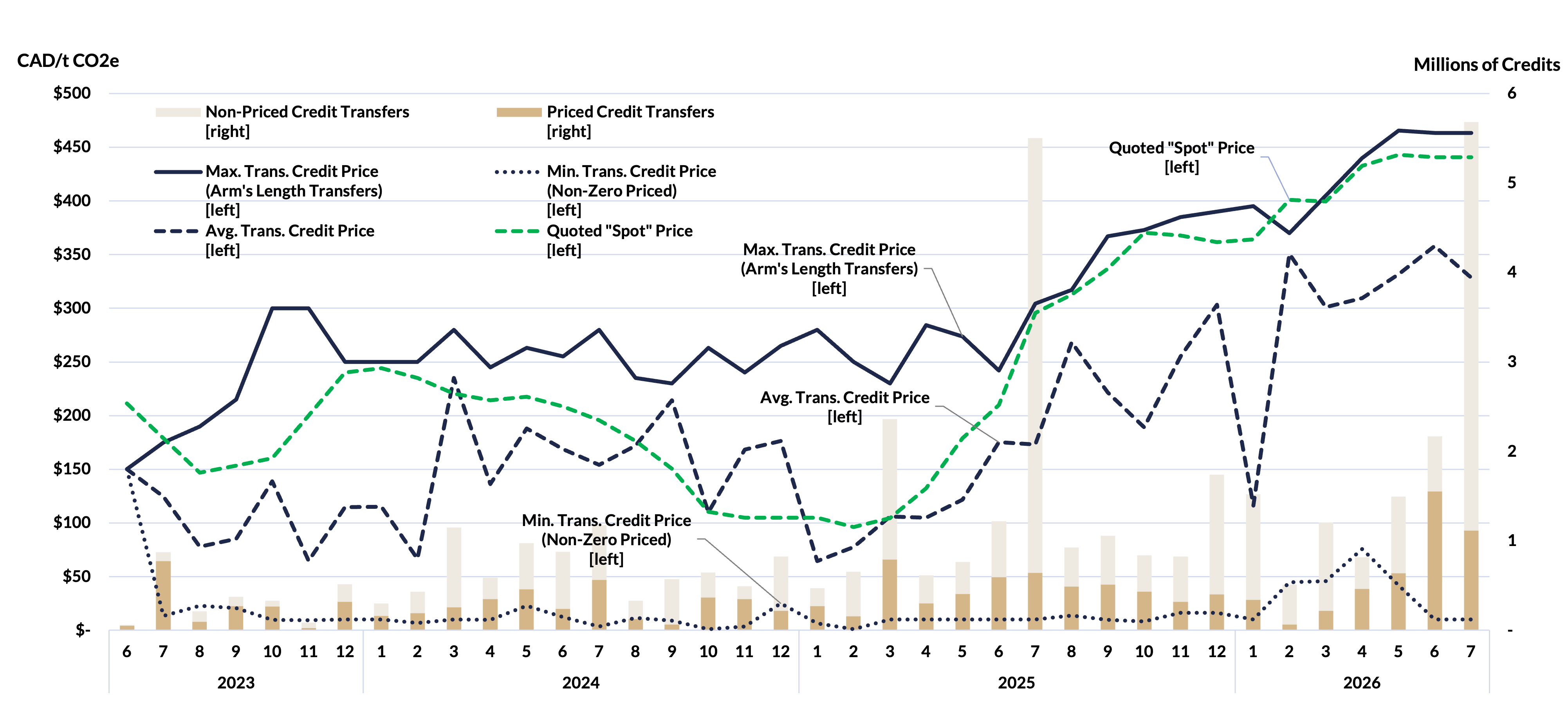
Environment and Climate Change Canada (ECCC) has now published data on monthly credit transfers up to July 2026. July 31 was the deadline for fuel suppliers to submit annual compliance reporting for 2025, and the July data showed a record-high volume of credit transfers prior to this compliance deadline.
Notably, most credit transfers were at a zero (or near-zero) price – presumably reflecting either non-arm’s length transactions or transfers bundled with other consideration. Nonetheless, based on ECCC reporting for transfers with a price – and consistent with “spot” market quotes – CFR credit prices have steady increased since 2025 to record high levels in recent months.
Across such priced transfers, ECCC’s reported average monthly credit price does not accurately reflect the market of monthly spot quotes for CFR credits. 1 ECCC’s data release specifically noted that the published data for April and June 2026 and Q2 2026 includes two transfers between affiliated parties in each month reported at a price of $580 with the next highest reported transfer prices in those months were $440 and $463.50, respectively. The maximum price for arm’s length transfers reported by ECCC more closely tracks the spot market. Broker quotes for CFR credit prices have generally been well above $400 since April 2026.2 Market participants report some recent weakening of quoted CFR prices, with some evident concern that regulatory amendments to provide a multiplier on domestically produced biofuels will result in a glut in the supply of CFR credits. As we discuss further below, publication of draft amendments for the federal government’s targeted regulatory amendments remains outstanding and could reshape the future supply-demand balance. Nonetheless, other economic fundamentals point to surging CFR credit prices required for attracting supplies of HDRD in Canada to meet credit demand.
CFR Credit Price Distribution (Q2/2026)
ECCC Quarterly CFR Credit Market Reporting
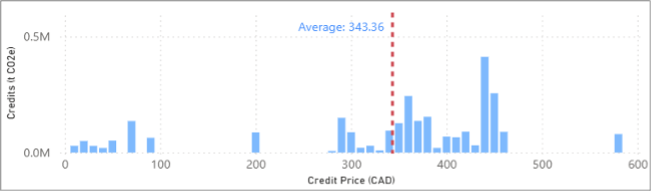
In contrast, the monthly average is distorted by a volume of transfers at low (but nonetheless non-zero) prices – with such volumes likely reflecting agreements that bundle other consideration or earlier commitments by credit creators who did not anticipate the swift climb in CFR credit prices. Indeed, ECCC included a histogram for Q2/2026 in its data release that highlights the skewed distribution of prices for credit transfers.
Rising HDRD (and feedstock) costs propel CFR prices
Increasing CFR prices follow from the rising cost of HDRD and, in turn, the higher costs of key feedstocks for producing HDRD. From ECCC reporting on credit creation in 2024 (the most recent year for reporting of feedstock composition), most HDRD was produced from animal fats, used vegetable (cooking) oil, canola or soybean oil, and prices for HDRD have historically tracked the costs of these feedstocks.
Hydrogenation-Derived Renewable Diesel (HDRD) and Feedstock Prices
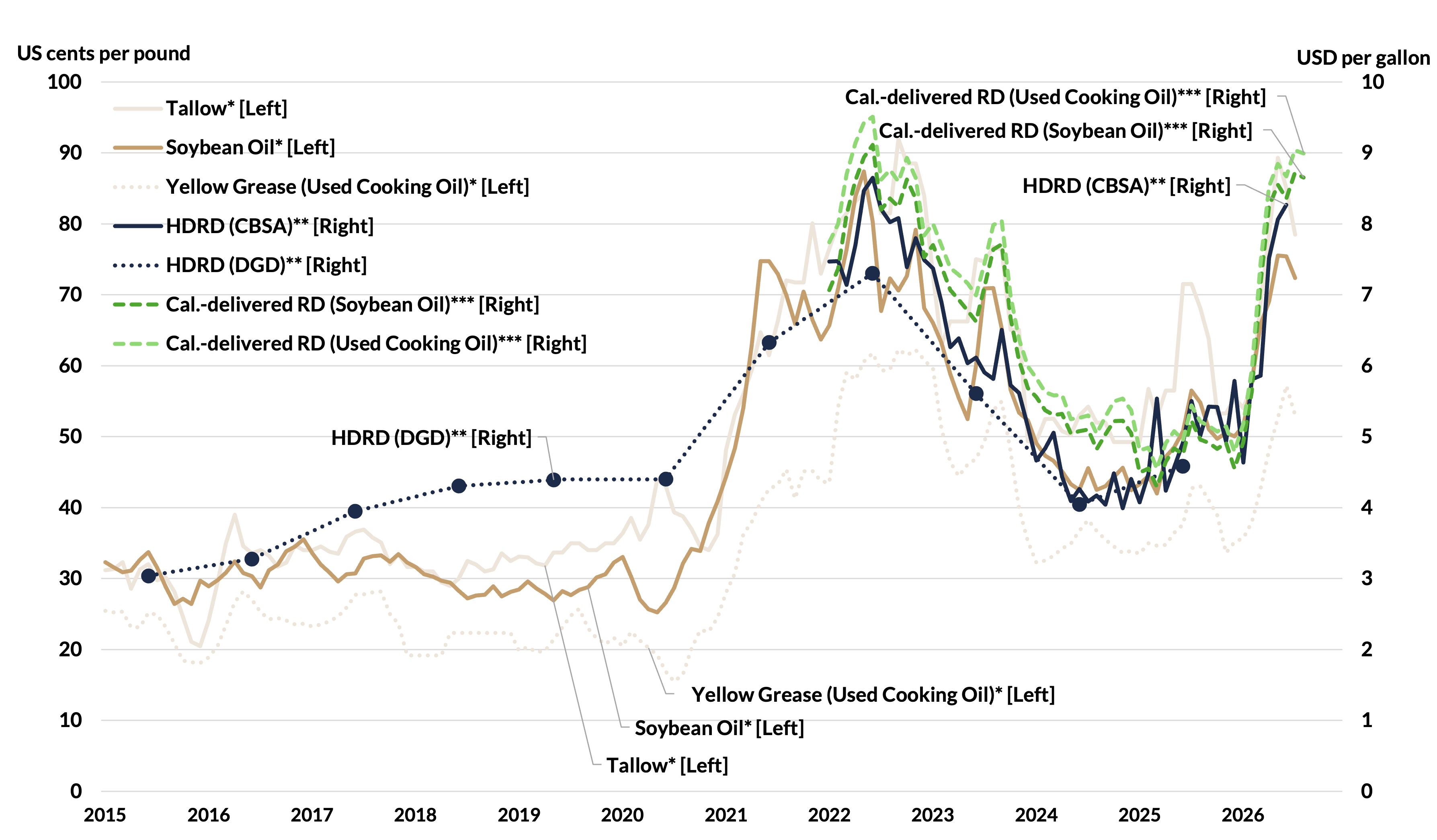
** Prices for HDRD derived annually from Darling Ingredients’ corporate reporting for its Diamond Green Diesel (DGD) subsidiary and monthly (for 2022 onwards) from weighted average unit values of imports from International Merchandise Trade reported by Statistics Canada based on Canadian Border Services Agency (CBSA) data, converted to USD at monthly exchange rates from the Bank of Canada
*** Spot prices quoted for California delivery of Renewable Diesel produced from Soybean Oil or Used Cooking Oil
As explained in an earlier note, CFR credit prices must compensate for the cost difference for providing the marginal low-carbon fuel versus its fossil-derived equivalent. This is because the fuel supplier faces a higher cost for supplying a blended biofuel or a “drop-in” substitute for conventional diesel or gasoline, but customers pay the same pump price regardless of whether a low-carbon fuel is actually supplied. Therefore, the credit value for the low-carbon fuel together with the credit cost for supplying the gasoline or conventional diesel equivalent should equal the cost difference.
Put another way, a supplier should rationally only supply a litre of HDRD if its cost difference with a litre of conventional diesel is compensated by the credits earned plus the credits otherwise required for supplying diesel multiplied by the credit price.
Illustration of required CFR credit price to compensate for HDRD vs. Diesel wholesale price difference
CAD/L
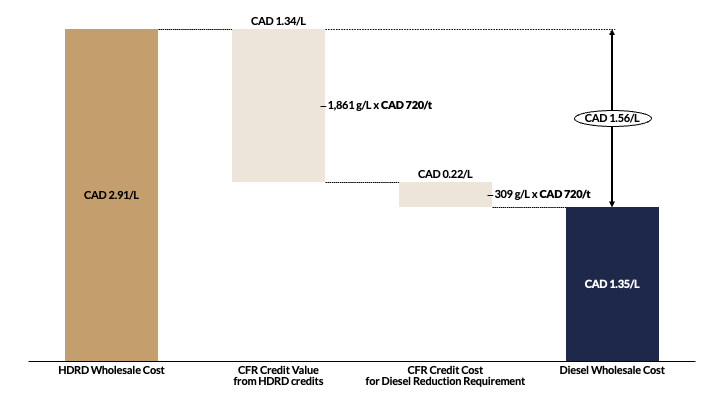
On this economic reasoning, consider an illustrative calculation for the “breakeven” CFR credit price for supplying HDRD in Q2/2026:
- From Statistics Canada import/export data for Q2/2026, the average unit export price for diesel from Alberta 3 Although Alberta also has a provincial blending mandate, the example assumes that the imported HDRD is supplied in Alberta, and Alberta is used for this example to ignore the influence of credits for the B.C. Low Carbon Fuel Standard (LCFS). was CAD1.35/L while the average unit import price for HDRD into Alberta was CAD 2.91/L.
- Assuming these import/export price data are reasonable proxies for the HDRD and diesel wholesale prices, 4 This assumed “wholesale price” of diesel differs conceptually from the “rack prices” at terminals for resellers and “wholesale customers” because, under the CFR, it is “primary suppliers” – either produce or import gasoline or diesel – that are subject to the CFR’s reduction requirement and rationally incorporate their CFR credit cost into their “rack price”. the value of CFR credits must compensate for a wholesale cost difference of CAD 1.56/L (i.e., CAD 2.91/L for HDRD – CAD 1.35/L for diesel).
- For 2026, supplying diesel incurs a reduction requirement of 8 g/MJ (or 309 g/L at the 38.650 MJ/L energy density for diesel specified in the CFR).
- From the most recent ECCC reporting in Q3/2025, the average volume-weighted carbon intensity of supplied HDRD was 32 g/MJ, and the reference carbon intensity for liquid low-carbon fuels is 85.3 g/MJ for 2026.
- Supplying such HDRD creates CFR credits at 53.3 g/MJ (or 1861 g/L at the 34.921 MJ/L energy density for HDRD specified in the CFR).
- Therefore, for the value of CFR credits to compensate for the wholesale cost difference at this assumed carbon intensity of HDRD, a CAD 720 per tonne CFR credit price would be required (i.e., CAD 1.56/L divided by 1861 g/L + 309 g/L and converted to tonnes).
Tightening CFR credit market (…?)
Ongoing attraction of supplies of low-carbon fuels, as well as other emission reductions and fuel substitution (e.g., EV recharging), will be required to create credits required to meet fuel suppliers’ increasing total reduction requirement for 2026.
ECCC has yet to publish any data on fuel suppliers’ actual compliance since the CFR took effect in July 2023. Nonetheless, we estimate suppliers’ reduction requirements from Statistics Canada annual gasoline and diesel volumes (adjusted for renewable blender inputs). 5 As of October 2025, ECCC disclosed that 13.6 million CFR credits were active of a total 30.7 million credits that had been created up to that date. This implies the use of 17.1 million credits for the 2023 and 2024 compliance years. Our estimates – based on Statistics Canada data on gasoline and diesel volumes (adjusted for renewable blender inputs) and annual g/MJ reduction requirements under the CFR – equal this implied CFR credit use for 2023 and 2024. Our estimates for earlier years are consistent with ECCC statements about CFR credit use. For 2025, ECCC has indicated that it estimated suppliers’ reduction requirement at 15.6 million tonnes. 6 Although not otherwise posting publicly, ECCC indicated this estimate in the covering text of an April 30 distribution email and reiterated this in the covering text of a July 14 distribution email. Notably, based on Statistics Canada data, we estimate fuel suppliers’ total reduction in 2025 could have required approximately 17 million tonnes. Even assuming no growth in unblended gasoline and diesel volumes between 2025 and 2026, we similarly estimate CFR credit demand would rise above 20 million for 2026. Again, publication of actual historical compliance data by ECCC is critical for accurately calibrating estimates from other higher frequency data sources.
ECCC does not maintain a transparent register of currently active CFR credits. 7 In contrast with the lack of disclosure on CFR credits, the Alberta Carbon Registries provides a detailed publicly-accessible inventory of all issued offsets and Emission Performance Credits (EPCs) under Alberta’s TIER industrial emissions pricing regime – including the originating facility/project and the current owner. As well, ECCC has yet to publish data for CFR credit creation from low-carbon fuels (Compliance Category 2) in Q4/2025 or from other emission reductions along the lifecycle (Compliance Category 1 – e.g., carbon capture) and fuel substitution (Compliance Category 3 – e.g., EV recharging) in 2025. Nonetheless, ECCC disclosed that 13.6 million active CFR credits were active as of October 2025 and subsequently disclosed that 24 million compliance credits were available for 2025 compliance as of July 1, 2026. This would imply the creation of 14 million CFR credits during 2025. 8 The October 2025 total of 13.6 active CFR credits impliedly included credit creation from low-carbon fuels in Q1 and Q2/2025, the reported credit creation in these reports totalled 4 million. Additional CFR credits would have been subsequently created ahead of the July 31, 2026 deadline for fuel supplier compliance for 2025. Quarterly Credit Creation reports for low-carbon fuel suppliers were due for Q3/2025 on December 31, 2025 and Q4/2025 on March 31, 2026 while Annual Credit Creation Reports (for activities such as carbon capture and EV recharging) were due on April 30, 2026, and the Credit Adjustment Report for 2025 was due on June 30, 2026. As of this writing, ECCC has only published data for credit creation from low-carbon fuels to Q3/2025 – totaling 4.1 million during that quarter. As well, ECCC indicated (in covering text to a distribution email) over 3 million credits created from adjustments in 2025. Impliedly, an additional 3 million credits were created from CC1 and CC3 during 2025, along with those from CC2 in Q4/2025.
Estimated CFR Credit Market Balance
CFR Credits (Tonnes CO2e)
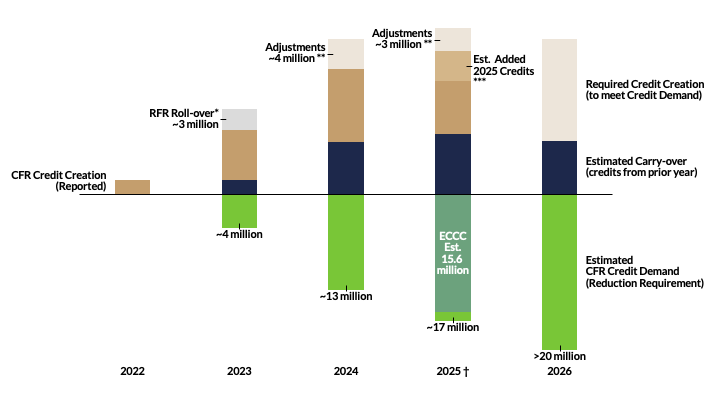
** As of October 2025, ECCC stated that approximately 4 million credits had been created for adjustments following approval of final carbon intensities, and ECCC indicated in July 2026 that 3 million credits were created following the 2025 Credit Adjustment Reports.
*** To date, ECCC has only reported CFR credit creation from low-carbon fuels until Q3/2025, and therefore credit creation from low-carbon fuels for Q4/2025 and from emission reductions across the lifecycle and fuel substitution for 2025 have been estimated based on ECCC disclosure implying 14 million credits created in 2025.
† ECCC has disclosed that it estimates the total reduction requirement in 2025 was 15.6 million tonnes; however, based on data from Statistics Canada on annual gasoline and diesel volumes (adjusted for renewable blender inputs), we estimate that the total reduction requirement as high as 17 million tonnes.
Credit availability in 2025 was then sufficient to meet fuel suppliers’ total reduction requirement in 2025. ECCC’s disclosure implies approximately 7 to 8 million CFR credits for carry-over to use against fuel suppliers’ 2026 reduction requirements following the July 31 deadline for 2025 compliance. Nonetheless, even with this carry-over, credit creation will need to keep pace to meet fuel suppliers’ total reduction requirement in 2026.
An important looming question for the supply-demand balance of the CFR credit market is the design and timing of “targeted amendments”, which were floated by the Government of Canada in a December 2025 discussion paper for a consultation period closing January 15, 2026. These proposed amendments came in response to concerns about the competitiveness of Canadian biofuel producers relative to imported low-carbon fuels from the U.S. and parallel proposals to prioritize domestic supply under the U.S. EPA’s RFS.
The discussion paper for the targeted amendments had proposed two options – a credit multiplier for domestically produced biofuels or a minimum domestic content requirement. Introducing a multiplier for domestically produced biofuels could significantly impact the market balance under the CFR, with consequent impacts to CFR credit prices.
Market participants had anticipated prompt publication of the draft amendments early in 2026. However, Canada’s mounting trade tensions with the U.S. – particularly the current negotiations over the United States-Mexico-Canada Agreement (USMCA) – have likely delayed the federal government’s further moves on this front.
Canada’s CFR competes with U.S. regimes for low-carbon fuels
Because low-carbon fuels like HDRD have a higher production cost (and wholesale price) relative to a fossil fuel equivalent, the value of credits under a respective regulatory regime must compensate for the cost difference for a fuel supplier to supply a low-carbon fuel. As well, since these low-carbon fuels can be physically exported and imported, attracting supply requires credit prices to equalize supply costs between markets. The majority of reported credits created under the CFR result from imported low-carbon fuels. 9 ECCC present reporting does not provide a full breakdown for the source of all credits created to date. Again, ECCC has not yet reported the details of credit creation from low-carbon fuels for Q4/2025 or for Compliance Categories 1 and 3 for 2025. As well, while ECCC has stated that 4 million credits were additionally created for adjustments following approval of final carbon intensities, ECCC has yet to update the prior reporting to detail how these additional credits were distributed across the supply of low-carbon fuels (i.e., whether for imported or domestically produced).
To attract supply to meet demand, Canada’s CFR credits must provide equivalent compensation as suppliers would otherwise earn in the U.S. for supplying a low-carbon fuel like HDRD. 10 In Canada, CFR credits are “stackable” with (i.e., can be combined with the value from) credits under parallel provincial regimes like B.C.’s Low Carbon Fuel Standard (LCFS). However, as discussed in our earlier note (see “Understanding Canada’s Other Carbon Price”), we expect that the required supply of low-carbon fuels under the CFR to exceed the total required supply under provincial regimes. Therefore, the CFR credit requirements will be the binding constraint with the CFR credit price compensating the marginal supply of low-carbon fuels to meet its higher requirements. Accordingly, since CFR credits can be earned by supplying low-carbon fuels in any province, the credit price under the B.C. LCFS should reflect only any comparative logistics costs of supplying the marginal low-carbon fuel to meet the B.C. LCFS requirements relative to supplying elsewhere in Canada. The below chart illustrates the implications for the required CFR credit price since 2022 to compensate a supply of HDRD with a 32 g/MJ carbon intensity equivalently to the combined value this low-carbon fuel would receive in the form of D4 RINs under the U.S. Renewable Fuel Standard (RFS) administered by the U.S. Environmental Protection Agency (EPA) and California’s Low Carbon Fuel Standard (CA LCFS). 11 Although these different regulatory regimes use different models for computing the lifecycle carbon intensity of the same fuel pathway, the calculations for this chart assume that the given HDRD fuel pathway has the same 32 g/MJ carbon intensity under both Canada’s CFR and the CA LCFS. From CA LCFS quarterly reporting, the average carbon intensity of renewable diesel supplied under that regime was 45 g/MJ in Q3/2025 and 47 g/MJ in Q1/2026 (the latest quarter reported). In comparison, the latest ECCC reporting of the average carbon intensity of HDRD supplied under the CFR is 32 g/MJ in Q3/2025.
Required CFR Credit Price
(HDRD at 32 g/MJ Carbon Intensity)
CAD/Tonne CO2e
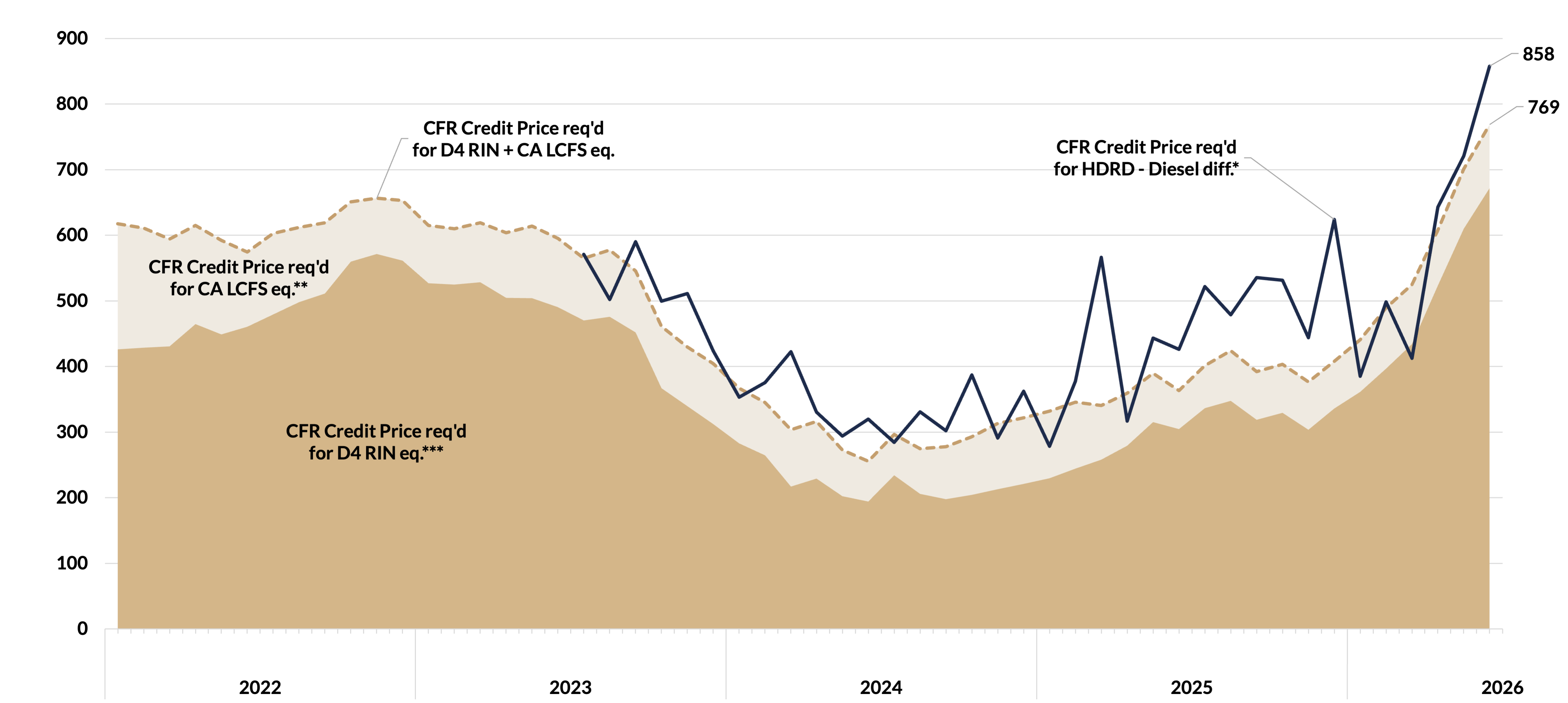
** Required CFR credit price for equivalence with value from CA LCFS calculated based on (a) the monthly reported transfer price for CA LCFS credits, multiplied by (b) the credits created by supplying HDRD with a 32 g/MJ carbon intensity under the CA LCFS in the given year, divided by (c) the credits created by supplying HDRD with the same carbon intensity under Canada’s CFR in the given year, and (d) converted to CAD/t at the monthly exchange rate.
*** Required CFR credit price for equivalence with value from D4 RINs under U.S. EPA RFS calculated based on (a) the monthly reported USD/RIN transfer price for D4 RINs, multiplied by (b) the legislated 1.7 RINs per Gallon created by supplying renewable diesel in the U.S., divided by (c) the credits created by supplying HDRD with 32 g/MJ carbon intensity under Canada’s CFR in the given year, and (d) converted to CAD/t at the monthly exchange rate.
This required CFR credit price is calculated based on monthly reported prices for credit/RIN transfers and the crediting parameters under the respective regime in the given year, converted at the monthly CAD/USD exchange rate reported by the Bank of Canada.
For comparison, the chart also shows the required CFR price to compensate for the price difference between HDRD and diesel (based on the average unit price from Canadian import/export data) assuming HDRD with a 32 g/MJ carbon intensity.
As illustrated, the estimates for the required CFR credit value are roughly consistent across time between these two approaches. Notably, both approaches indicate required CFR credit values in excess of CAD 700/t as of mid-2026 to either provide equivalent value for supplying HDRD as under U.S. regimes or compensate the HDRD-Diesel whole price difference.
Put another way, Canada’s fuel suppliers are forgoing profit if they are importing HDRD from the U.S. to monetize the resulting CFR credits at less value than they would otherwise earn from the RINs (and other LCFS credits) that they would create for supplying the same volume of fuel stateside.
This reasoning points to ongoing upwards pressure on CFR credit prices to attract HDRD supply to meet the accelerating demand for credits under Canada’s CFR.
Demand for low-carbon fuels to meet Canada’s accelerating CFR credit requirements in future years will also coincide with heightened volume requirements under the U.S. EPA’s RFS. Announced by the U.S. EPA in March, the final RFS volumes for 2026 and 2027 especially increased the Renewable Volume Obligations (RVOs) for Advanced Biofuels (D5) by over 50% from 2025 and “nested” Biomass-based Diesel (D4) by over 60% from 2025. 12 The “nesting” of requirements under the U.S. EPA’s RFS means that fuel volumes in the categories of Cellulosic Biofuel (D3) and Biomass-Based Diesel (D4) each apply to meet the respective D3 and D4 volume requirements but also apply for the Advanced Biofuel (D5) volume requirements and, in turn, the Conventional Renewable Fuel (D6) volume requirements. In recent years, the supply of renewable diesel volumes (qualifying for D4 RINs) have met the substantial majority of D5 volume requirements, followed by biodiesel volumes (also qualifying for D4 RINs).
U.S. EPA RFS Renewable Volume Obligations (RVO) for Advanced Biofuel
with Renewable Diesel and Biodiesel Consumption and Production Capacity
Million U.S. Gallons
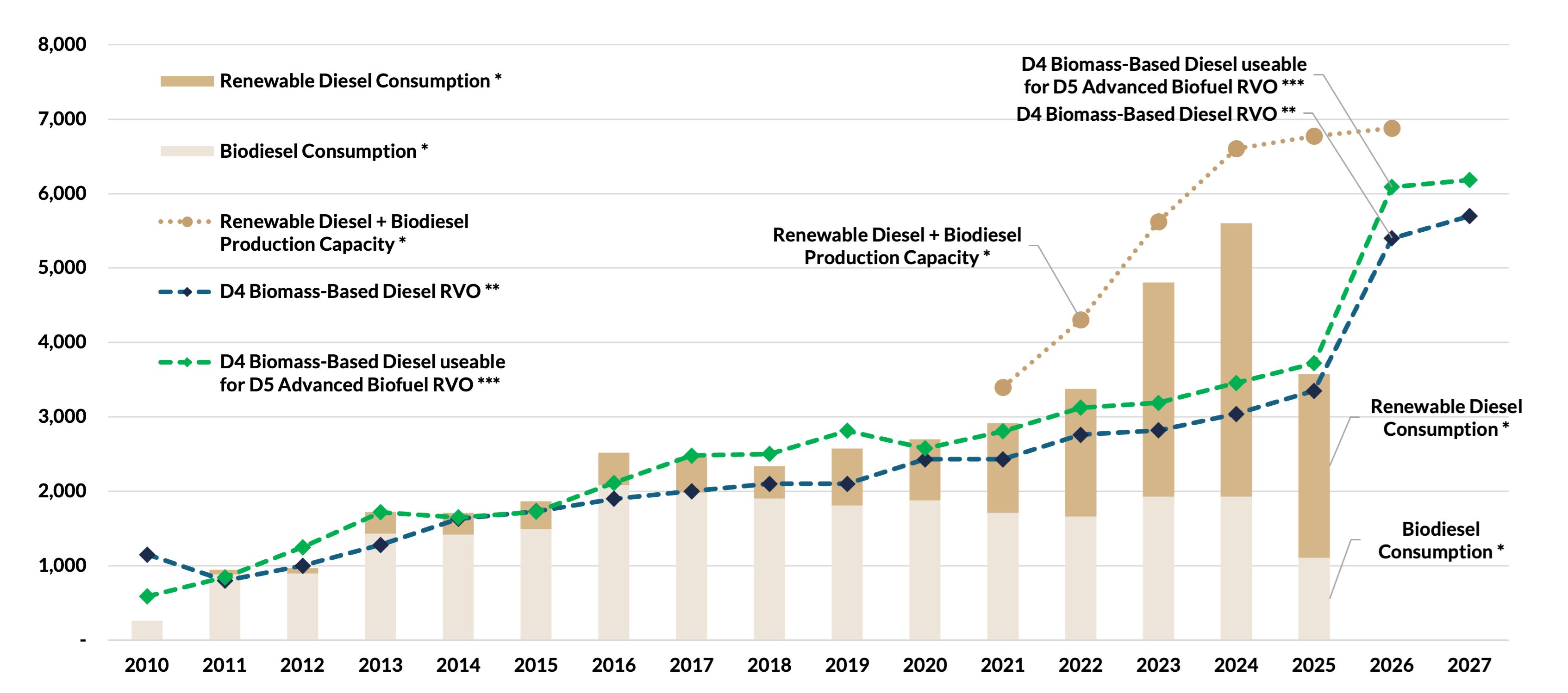
** D4 (Biomass-Based Diesel) RVO specified by U.S. EPA in gallons of biomass-based diesel.
*** Useable D4 volumes to fulfill D5 RVO calculated by deducting D3 (Cellulosic Biofuel) RVO from D5 RVO (each specifically in ethanol-equivalent volumes) and converting to biomass-based diesel volumes (i.e., dividing by 1.6 to reflect equivalent value for gallons of renewable diesel and biodiesel).
Notably, U.S. consumption of D4 volumes in 2023 and 2024 exceeded volumes useable to fulfill D4 and D5 RVOs for those years. In 2025, U.S. consumption of D4 volumes returned to levels in-line with that year’s RVO. Although substantial D4 RINs remain available from the 2024 vintage, 13 RINs from a prior year can be used against the next year’s RVO; however, the RFS regulations limit carry-over by restricting use of RINs from the prior year’s vintage to 20% of the obligation for the given compliance year. the heightened D4 and D5 RVOs for 2026 and 2027 will require additional supply.
As shown above, the increased RVOs for 2026 and 2027 will potentially utilize high amounts of the current U.S. production capacity for renewable diesel and biodiesel. In recent years – with increasing imports to fulfill CFR requirements since 2022 – Canada’s imports of HDRD and biodiesel have represented around 10% of U.S. production.
As well, as part of its announcement of final rulemaking for 2026/27, the U.S. EPA also indicated plans that, starting in 2028, foreign fuels and feedstocks will receive half the RFS compliance value compared with U.S.-produced biofuels. The EPA had earlier consulted on such domestic preferences for its 2026 and 2027 standards but indicated that it delayed implementation to provide the U.S. biofuels industry time to prepare.
The consequent shifts in supply chains and trade incentives for U.S. biofuel production will have significant implications for the supply-demand balance and production costs for biofuels across North America – impacting compliance costs under the U.S. RFS and the Canadian CFR (particularly if Canada implements its own domestic producer preferences).
In coming years, heightened RVOs under the U.S. RFS, Canada may be increasingly competing for the low-carbon fuels to meet accelerating CFR credit demand. With higher costs for producing greater volumes of low-carbon fuels – alongside potential feedstock constraints and upwards pressures on carbon intensity – even higher CFR credit prices may be required to compensate supply costs and for price equivalence with supplying low-carbon fuels in the U.S.
New biofuel production facilities and decarbonization projects – especially carbon capture and storage – can benefit from CFR credits as a revenue source. However, data-driven analysis around commodity flows and credit price dynamics across these interlinked markets is critical for confidently planning investments and operations.