Alberta TIER’s 2025 credit retirements
Implications of declining obligations for credit bank and prices
July 9, 2026
June 30th was the deadline for facilities to meet their 2025 compliance obligations for Alberta’s TIER industrial carbon pricing regime. To satisfy their obligations, facilities with obligations were required to either retire Emission Performance Credits (EPCs) or Offsets or purchase compliance credits from the Alberta government’s TIER Fund.
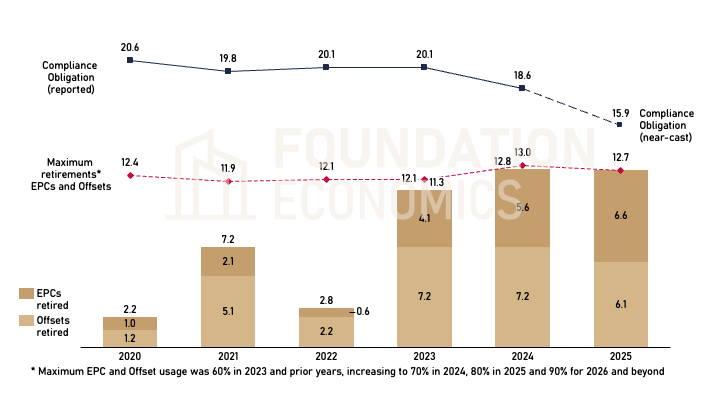
From Alberta Carbon Registries data, we calculate that 12.7 million tonnes of EPCs and Offsets were retired to satisfy TIER-regulated emitters’ 2025 compliance obligations.
For 2025, the maximum EPCs and Offsets that an emitter could retire was 80% of its obligations (the remaining 20% must be met by payments to the TIER Fund at $95/tonne). From our “near-casting” of 2025 obligations (based on our facility-level model for the TIER regime and end-of-year operational data across facilities), these actual retirements closely tracked our estimate of the maximum potential retirements for 2025 compliance.
Retirements of Emission Performance Credits (EPCs) and Offsets
Megatonnes CO2e
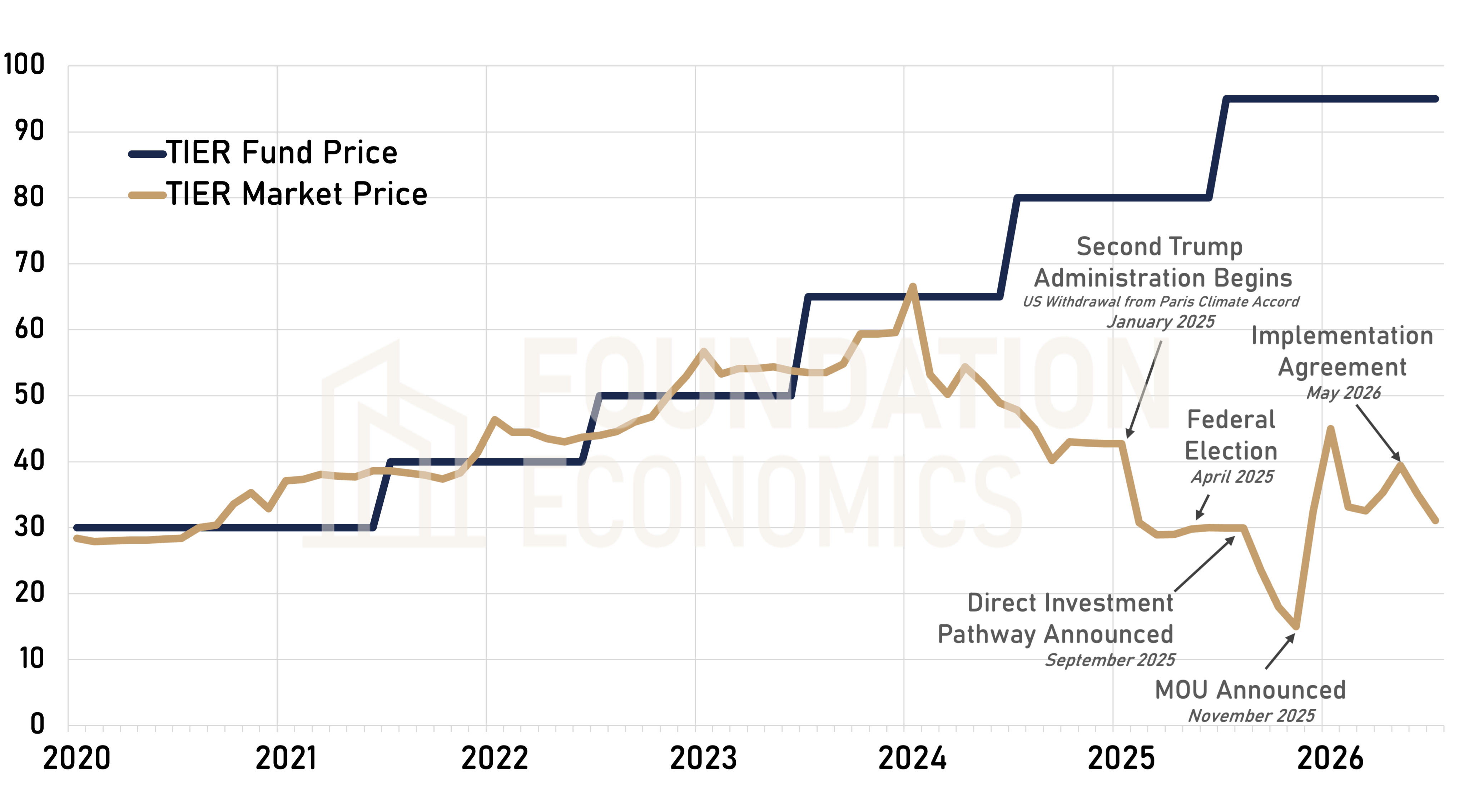
Despite improved policy certainty under the Implementation Agreement reached between Canada and Alberta in May 2026 (see our earlier note "Alberta Carbon Market Reset"), market EPC/Offset prices have remained stagnant at just over $30/tonne.
At such a discount to the alternative $95/tonne TIER Fund (or “headline”) price for 2025 compliance, regulated emitters under TIER have a strong incentive to maximize retirements of EPCs and Offsets to satisfy their obligations.
Historical TIER Market Price vs. Fund Price
CAD per tonne CO2e, Monthly Average
Assuming all emitters satisfied 80% of their obligations with EPC/Offset retirements (the regulatory maximum for the 2025 compliance year), implied emitter obligations were 15.9 Mt in 2025 (again, closely tracking our near-casted estimates). Despite the general 2% tightening of benchmarks across facilities, this represents a significant decline in obligations in 2025 from 2024.
Compliance "True-up" Obligations by Sector
Megatonnes CO2e
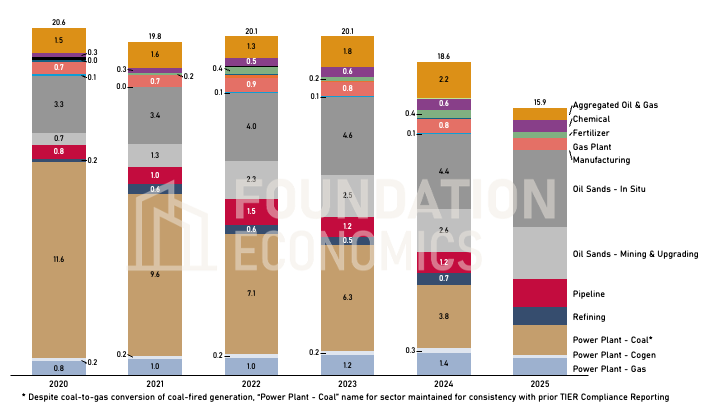
Much of the decline in obligations from 2024 to 2025 owes to the opt-out of most Aggregated Oil & Gas facilities1 Under TIER, the operator of two or more conventional oil and gas facilities can apply to aggregate these in order to streamline reporting and compliance. from participation in TIER following the federal government’s elimination of the fuel levy (or “carbon tax”) effective April 1st.
The underlying facilities of such Aggregated Oil & Gas facilities fall below the emissions threshold that requires mandatory participation in TIER (100,000 t CO2e/year). Nonetheless, these facilities still had a strong incentive to participate in TIER prior to April 1st and thereby avoid the federal carbon tax because the federal carbon tax applied to 100% of their fuel-related emissions and applied a charge equivalent to the TIER fund price.
In contrast, under TIER, these facilities only face a compliance obligation on the portion of their emissions that exceed their benchmark and their unit cost of compliance is lower reflecting a blended average of the TIER fund price and the market price for EPCs and offsets.
With the carbon tax now eliminated, all Aggregated Oil & Gas facilities with obligations would be expected to opt-out of TIER participation for future years (facilities with emission intensity lower than their facility-specific benchmarks would still continue to opt-in as long as they are generating EPCs). However, for 2025, many such facilities still retired EPCs/Offsets in respect of obligations for the first quarter (i.e., when the federal fuel levy remained in effect).
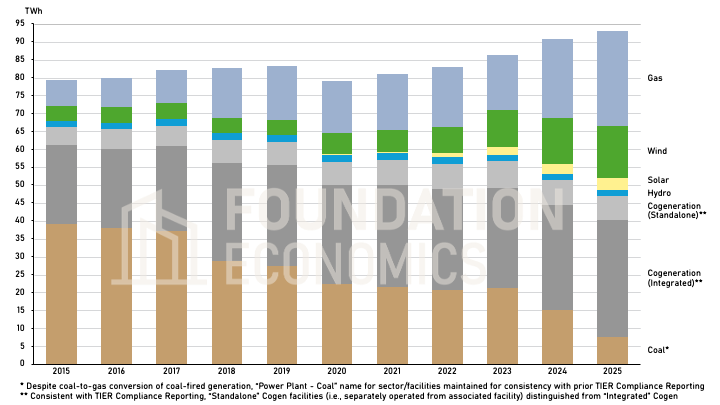
Significant apparent declines in obligations were also seen across power plants: 2025 was the first full year following the retirement of Alberta’s last coal-fired power plants (Genesee Units 1 and 2). Note, some formerly coal-fired steam units have been converted to use natural gas (which, for consistency with history, we continue to code as “Coal”). Moreover, 2025 was also the first year of operation for the Cascade and Genesee’s repowered combined-cycle natural gas (CCGT) power plants. The replacement of generation from newer, higher efficiency gas-fired plants contributed to the decline in obligations.
Alberta Annual Power Generation by Fuel Type*
Terawatt Hours (TWh)
Notably, despite the 2% annual tightening of facilities’ benchmarks and significant growth in production, obligations for the Oil Sands sectors increased only modestly in 2025.
This muted growth in obligations implies overall improvements in emission intensity across both the Oil Sands In Situ and Mining & Upgrading sectors. Based on facility-level operational data from the Alberta Energy Regulator, bitumen production by TIER-regulated In Situ facilities increased by roughly 3% in 2025. Mining & Upgrading facilities similarly increased both bitumen and synthetic crude oil (SCO) production by roughly 3%. As well, at Suncor’s base plant, the full-year operation of the upsized cogeneration unit (replacing its prior coke-fired boiler) reduced this facility’s obligations between 2024 and 2025.
In one respect, the decline in obligations for 2025 represents a success story for the TIER regime reflected in the apparent improvement of emission intensity in key sectors like oil sands, phase-out of coal-fired generation, entry of higher efficiency gas-fired power plants, and the continued roll-out of non-emitted wind and solar generation (approximately 860 MW energized in 2024 and 845 MW entering service in 2025).
Nonetheless, the significant decline in obligations for 2025 – and particularly the absence of Aggregated Oil & Gas obligations from April 2025 onwards – points to continued upwards pressure on the EPC/Offset bank.
At present, issued and active Offsets and EPCs total 46 Mt. However, a significant “shadow bank” of EPCs and Offsets has yet to be issued for 2025 as well as earlier years. With pending EPC and Offset issuance, the EPC/Offset bank will remain greater than three-fold the 2025 obligations until the next wave of retirements at the 2026 compliance deadline.
Despite the greater policy certainty provided by the May 2026 Canada-Alberta Implementation Agreement, the limited 2025 drawdown of the EPC/Offset bank represents a downward pressure on EPC/Offset prices. Empirically, EPC/Offset prices track the “years of inventory” (the EPC/Offset bank relative to annual obligations – again, over 3x presently). Economically, the TIER Fund price will not “bind” as the marginal cost of compliance – and thereby set the price of EPCs and Offsets – until the future year at which the bank has been drawn-down and TIER's maximum retirements (90% of obligations for 2026 onwards) consistently exceed EPC/Offset creation.
Looking ahead, as benchmarks tighten and major TIER participants roll-out decarbonization projects (e.g., the Oil Sands Alliance’s “Pathways” carbon capture and storage) and new generation, the market balance in coming years will determine the outlook for EPC/Offset prices.
In this context, projections for future emissions, obligations, and creation of EPC and Offsets are essential to understand the outlook for the EPC/Offset bank – and fundamental value for EPCs/Offsets today.