2025 Alberta TIER Compliance Results
Declining Obligations and rising EPCs point to ongoing oversupply
September 25, 2026
Alberta’s Environment & Protected Areas (AEPA) has published the 2025 sector-level compliance results under the Technology Innovation and Emission Reduction (TIER) Regulation.
Consistent with our earlier note following the June 30th compliance deadline (and credit retirements), the report confirmed emitters 15.9 Mt of “true-up” obligations for the 2025 compliance year – a significant decline from obligations in prior years. The EPA also reported 7.2 Mt of EPCs requested for 2025 – a significant increase from 2024. As a share of TIER-regulated GHGs, obligations and net obligations (less EPCs and Offsets issued to-date) continued to decline from prior years.
This points to ongoing oversupply of the TIER credit market. A growing TIER credit bank for the 2025 compliance year – and increasing “years of inventory” – will likely continue to weigh on credit prices.
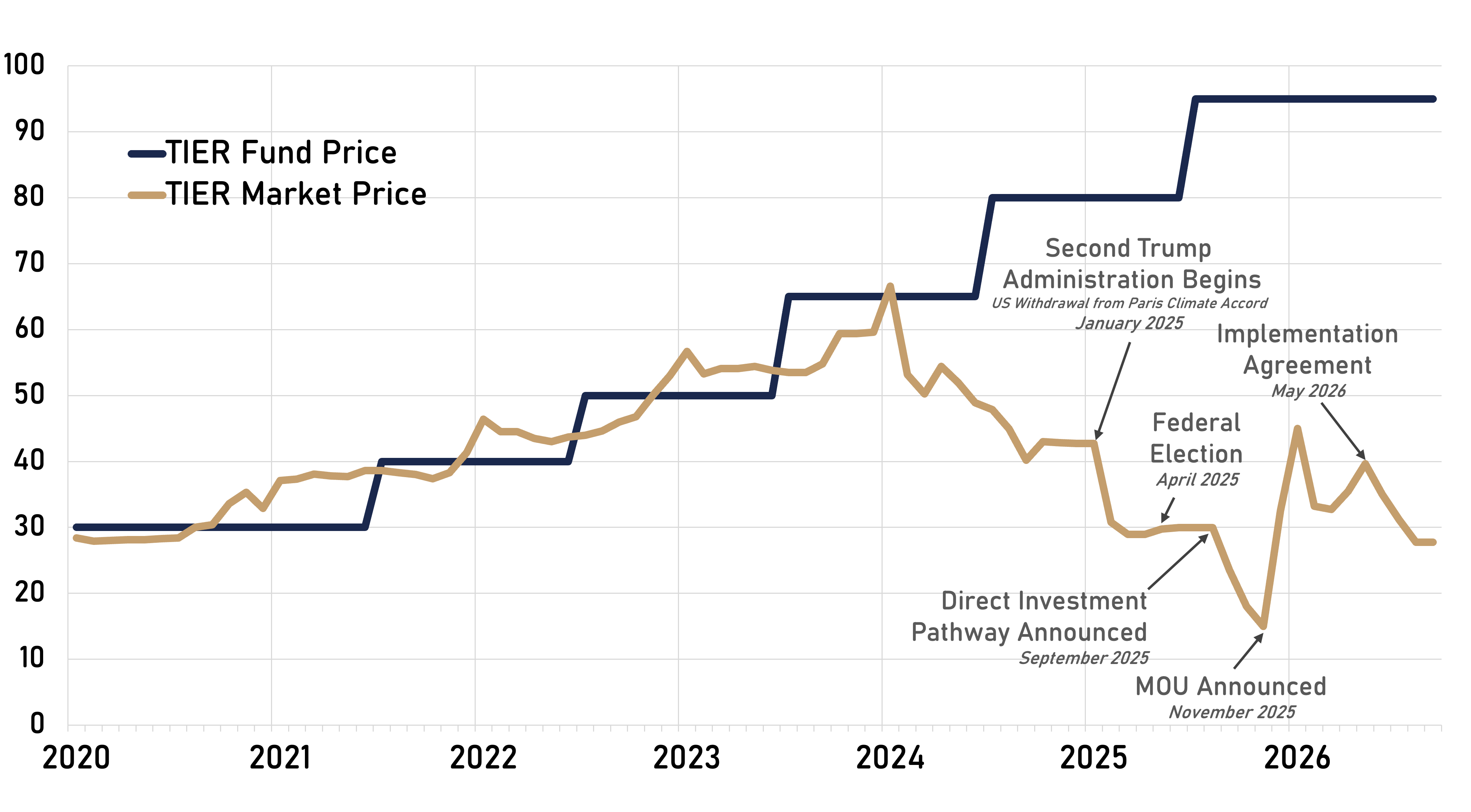
Notably, TIER credit prices further sagged in August. While the May Implementation Agreement expressly aimed to restore confidence in the TIER credit market, credit price have continued to sag. This reflects participants’ ongoing uncertainty and market expectation for a protracted horizon for the draw-down of the current ~60 Mt bank (including pending issuance) of EPCs and Offsets.
TIER Market Credit Price vs. Fund Price
CAD per tonne CO2e, Monthly Average
Compliance "True-up" Obligations by Sector
Megatonnes CO2e
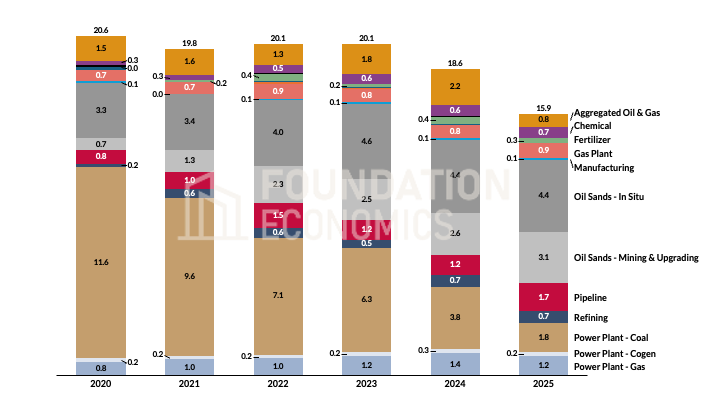
The EPA’s report confirmed emitters’ 15.9 Mt of “true-up” obligations for the 2025 compliance year – a significant decline from 18.6 Mt in 2024 and 20.1 Mt in 2023.
Despite the general tightening of benchmark stringency under TIER by 2% annually, this decline in obligations primarily owed to the continuing decarbonization of power generation and the opt-out of many Aggregated Oil & Gas facilities following the elimination of the federal fuel levy on April 1, 2025. 1 Aggregated Oil & Gas facilities reflect the combination of an operator’s multiple conventional oil and gas facilities (which are not otherwise mandated to participate in TIER as “large emitters”) for streamlining reporting. Following elimination of the federal fuel levy on April 1, 2025, most Aggregated Oil & Gas facilities no longer had incentive to participate in TIER. A facility avoided the levy by opting into TIER but, once the federal fuel levy was eliminated, a facility that would otherwise face obligations would rationally opt out.
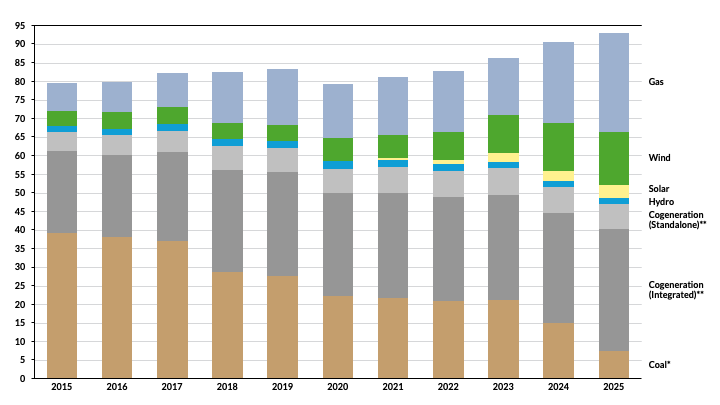
Generation from formerly coal-fired units continued to decline, reducing the obligations of these facilities, while obligations of gas-fired power plants have remained stable despite growing generation, owing to the low emission intensity of new gas-fired units.
Meanwhile, obligations of in situ oil sands facilities remained stable from 2024 despite the sector’s rising emissions and tightened benchmarks. This owed to reduced emission intensity across the sector, both from reductions at specific facilities and the composition of production between facilities.
Emission Performance Credits (EPCs) Requested by Sector
Megatonnes CO2e
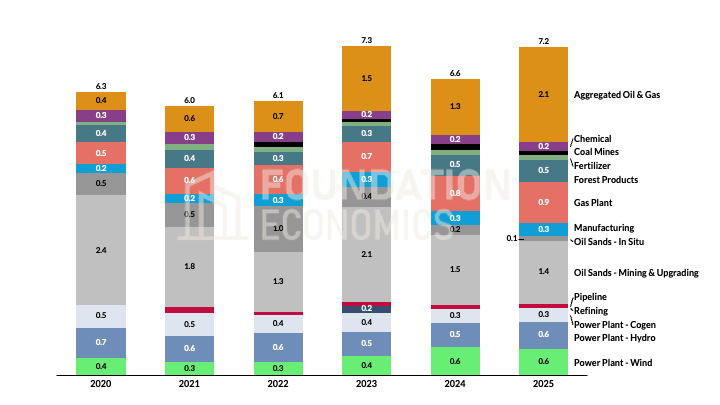
The EPA also reported 7.2 Mt of EPCs requested for the 2025 – a significant increase from the 6.6 Mt of EPCs requested in 2024.
The primary driver of this increase in EPCs was the surge in those from Aggregated Oil & Gas. Again, this appears a consequence of a “cream-skimming” incentive for Aggregated Oil & Gas facilities following the elimination of the federal fuel charge. That is, following this elimination, conventional oil & gas operators rationally reorganized how their facilities were aggregated in order to avoid obligations while maximizing the creation of EPCs. 2 Data from Petrinex confirms that Aggregated Oil & Gas facilities that remain opted into TIER now include only a subset of the underlying facility IDs that the same TIER facility code.
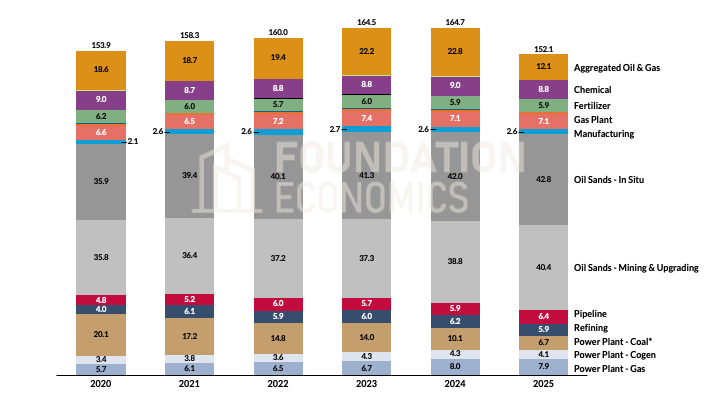
Total TIER-regulated emissions also declined significantly from 2024, falling to 152.1 Mt from 164.7 Mt. Part of this decline reflects real reductions from the continued decline in emissions from formerly coal-fired units for power generation. However, the majority of the fall in TIER-regulated emissions resulted from the opt-out (and reorganization) of Aggregated Oil & Gas facilities from participating in the TIER regime. That is, the underlying facilities continue to emit but are not within the TIER scope.
Nonetheless, despite the decline in emissions, obligations as well as net obligations (less EPCs and Offsets) continued to decline relative to GHGs.
TIER-Regulated Emissions by Sector
Million Tonnes CO2e
TIER Compliance Obligations Relative to Regulated Emissions
Share of TIER-Regulated GHGs
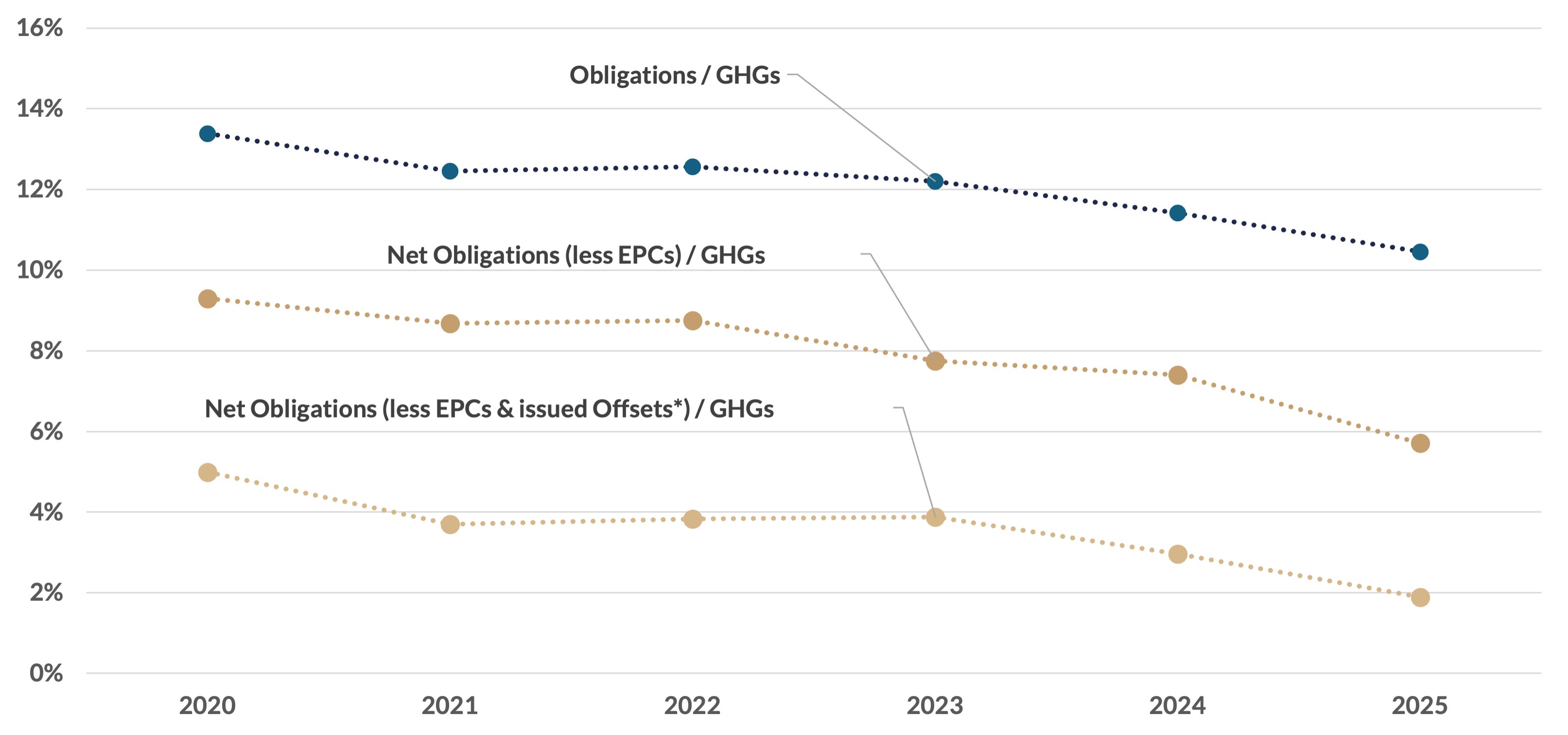
The selective opt-out of Aggregated Oil & Gas facilities (i.e., avoiding obligations while maximizing EPCs) was a major factor for this declining ratio in 2025.
Nonetheless, the long-term trend of declining obligations relative to regulated GHGs reflects overall improvements in emission intensity relative to the effects tightening of benchmarks.
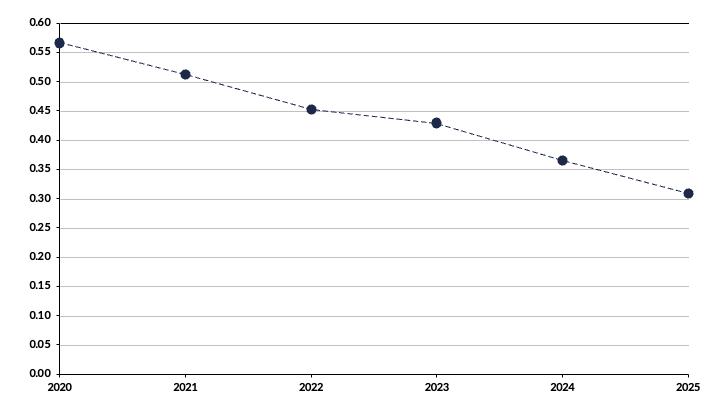
The continuing decarbonization or Alberta’s electricity mix continues to be a primary driver. Power generation from converted coal units has continued to decline, backfilled by greater generation by gas-fired units, cogeneration, and non-emitting (wind and solar) sources.
Importantly, the ramp-up of the upsized replacement cogeneration unit at Suncor’s base plant occurred during 2025. This transitioned from the previous coke-fired boiler to gas-fired cogeneration units. Although facility’s natural gas consumption increased, this was significantly offset by reduced combustion of highly emission intensive coke, and the exported power generation from this replacement (which is credited at the benchmark for electricity) contributed to a relative reduction in Suncor’s obligations.
The composition of growth for in situ oil sands production also continues to be critically important to extent of net obligations under TIER. That is, production growth has generally at facilities that have improved emission intensity and consequently face fewer obligations or create EPCs.
Annual Generation by Fuel Type
Terawatt-Hours (TWh)
** Cogeneration facilities classified as “Standalone” or “Integrated” based on whether units constitute separate facilities under TIER Compliance Reporting
Emission Intensity of TIER-Regulated Power Plants*
Tonnes CO2e per Megawatt-Hour (tCO2e/MWh)
These 2025 compliance results point to continued growth of the TIER credit bank – and consequent ongoing downwards pressure on credit prices as TIER market participants anticipate a protracted horizon for the draw-down of the bank.
Specifically, the 15.9 Mt obligations for 2025 translated into 12.7 Mt observed credit retirements. Across the TIER regime, facilities with obligations retired credits to the allowable maximum of 80% of obligations.
Looking ahead, the question for credit prices under TIER is the timeline for draw-down of the current credit bank. Specifically, by what future year will facilities’ maximum retirements to satisfy obligations exceed available credits? Only at this horizon will the alternative TIER Fund price “bind” as the marginal cost of compliance (i.e., the price that some facilities must be to satisfy obligations).
More immediately, market participants will closely watch indicators for how the TIER credit bank will evolve in 2026 year and will be very attuned to further specifics of policy-making under TIER.
For power generation, the recent trends of emission reductions have largely run their course. With increased Alberta load growth – further accelerated by potential data centre build-out – and renewable development stalled, Alberta faces a strong pull for increased gas-fired generation. With ongoing tightening of the electricity benchmark under TIER, the growing load served by gas-fired generation should increase.
As well, even with improvements in emission intensity, growth of oil sands production volumes and facilities’ benchmark tightening will continue to push obligations higher for the sector.
However, looming policy decisions represent a major uncertainty for future TIER market balances that in turn presently weigh on credit prices. In particular, the May 2026 Implementation Agreement preserved the “Direct Investment program” under which eligible expenditures on emission reduction projects would qualify for “Investment Credits” that can be retired to satisfy a company’s obligations under TIER or be substituted to “reactivate” other retired (tradable) credits. However, the present TIER Regulations do not specify the scope of eligible investments, and Alberta has yet to publish any draft for the “Standard for Direct Investment” under which this scope will presumably be specified.
Notably, Alberta committed in the May 2026 Implementation Agreement to “design and administer the TIER Direct Investment program, including the issuance and use of Investment Credits under the TIER Regulation and any future standard for Direct Investments, in a manner that preserves market function and the Effective Price.” However, market participants are highly attuned to the implications for Investment Credits to further increase the effective size of the credit bank under TIER and prolong the horizon to the drawdown of the TIER credit bank.
This uncertainty around the Direct Investment program contributes to present languishing credit prices. If Alberta publishes a Standard for Direct Investment with wide scope for the eligible expenditures for Investment Credits, market participants will reasonably anticipate a longer duration until the credit bank is drawn down, placing further downwards pressure on credit prices.